The $32 Trillion Problem Scott Bessent Can’t Buy His Way Out Of
The Treasury Department is trying to push interest rates down. But the bond market isn’t buying it, and the Fed and the Treasury are working at cross-purposes.
[1,620 words: a 6-minute read.]
Federal Reserve Chair Kevin Warsh and Treasury Secretary Scott Bessent are both President Donald Trump appointees but recent weeks make clear that they are working at cross purposes. Bessent has signaled that he’s prepared to take expensive and interventionist steps to reduce the interest rates (yields) on bonds, which the government issues to pay interest on what’s a ballooning national debt. Warsh, in a recent important address, has made clear that, under his stewardship, the Fed will remain committed to its 2% a year target for inflation and regards interest rate hikes as a means to contain inflation. As I’ll show, their goals have set them on a collision course.
Warsh Vs. Bessent
Under Warsh, the Fed has focused on keeping inflation under control, avoiding sudden moves to send signals to investors or to manipulate markets, relying instead on markets to set bond rates. By contrast, Bessent has announced plans to buy back T-Notes (10-year) and T-Bonds (30-year). He can pay for them in one of two ways: by using the proceeds from selling T-Bills or by tapping Treasury’s General Account, a checking account of sorts that it maintains at the Fed. (More on that account below.) By creating increased demand for T-Notes and T-Bonds through buybacks, Bessent hopes to push up the prices of both and lower the interest rate the government has to pay on them to attract buyers. How does that work? Well, the government says, in effect, “Hey, there’s a lot of demand for these bonds, so I don’t have to pay higher yields to attract buyers.”
But recall that 30-year bond prices influence 10-year T-Note prices: if you can lower the interest rate the government has to pay for the first, you also lower the interest rate for the second. By selling T-Bills and using his slush fund to buy 30-year bonds, then, Bessent is increasing demand for 30-year bonds and, by extension, for 10-year T-Notes. That lowers the rate the government has to pay to attract buyers—for both. And T-Note interest rates, all things being equal, translate into lower interest rates for consumer loans. That’s exactly what Trump wants, as the midterm elections draw near.
Uncle Sam’s Colossal Debt
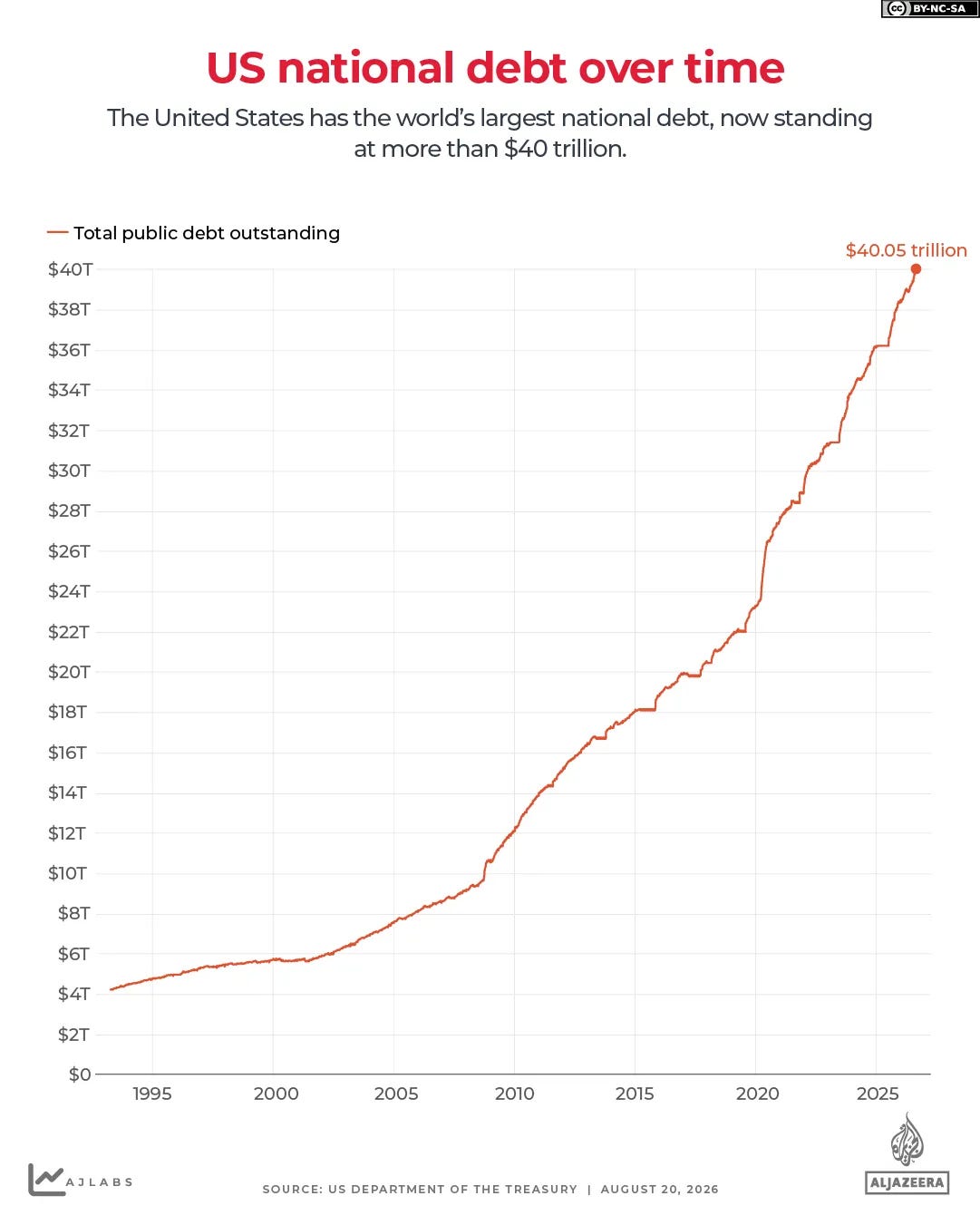
Bessent has another motive: lowering the government’s debt repayment costs. The total US national debt (see the chart below) has ballooned to $40 trillion. And the annual payment on that debt has soared to $1.2 trillion—that’s more than the Pentagon’s budget, even after the recent hike in defense spending. In his second term alone, Trump has raised the national debt by $3.8 trillion, or 10.6%. Bessent needs to raise bond prices, thereby lowering the interest rate the government must pay to attract buyers. That’s important because—to repeat an earlier point—the government pays interest on the national debt by issuing bonds.
Why Bessent’s Gambit Won’t Work
There are at least three problems with Bessent’s gameplan.
First, the money the Treasury will obtain from selling T-Bills in order to buy T-Notes and T-Bonds isn’t enough to significantly raise the price of Notes and Bonds. And that of course means Bessent’s strategy won’t lower the interest the government must pay to attract buyers of either. That also means he’s unlikely to lower the interest rate consumers pay for home and automobile loans.
Second, by intervening in the bond market, the Treasury is inadvertently communicating to potential buyers of T-Notes and T-Bonds that something is wrong: in effect, proclaiming, “Help! Uncle Sam’s debt is rising, as is the repayment cost, and I need to somehow push down the interest the government will have to pay to keep borrowing just in order to pay the interest on that debt.” That of course risks deterring investors from buying more T-Bonds and T-Notes and leads them to seek other investment opportunities—such as corporate bonds, which, as I discuss below, is precisely what they are doing.
Third, if Bessent’s plan is to sell T-Bills to buy T-Notes and T-Bonds, he has to constantly sell additional T-Bills when the ones he has sold expire and the payment comes due, which, recall, happens quickly because of their maturity timespan. Bessent’s plan also assumes that interest rates (yields) on T-Bills won’t start rising. If they do rise, and he continues with his strategy, he’ll in effect be taking out short-term loans at increasing rates of interest to buy back long-term debt. By contrast, when the government sells T-Bonds, the underlying interest rate is locked in for 30 years: even if interest rates soar, Uncle Sam knows up front what he has to pay in interest over that long period. Unlike with T-Bills, there’s no risk that the interest rate on a 30-year bond will move upward unexpectedly.
But despite the risks and the criticism of his plan by investors and financial experts, Bessent is upping the ante. He started by indicating that the Treasury Department would spend $4 billion to buy back T-Notes and T-Bonds, but then let it be known that he’d be willing to spend more than that by tapping the Treasury’s General Account. The General Account is basically the Treasury Department’s checking account at the Fed. It currently contains about $950 billion. That’s money from your taxes—and mine, too—but Bessent can use it without Congress’s approval because it isn’t new spending or revenue: it’s already in Treasury’s piggy bank. Underlying this strategy is Bessent’s confidence that he can spend enough money buying T-Notes and T-Bonds to increase demand and price, and in doing so, lower the rates the government has to offer buyers.
Bessent’s Piggy Bank Looks Huge, But That’s Deceptive
Can Bessent be sure that he will achieve his objective even if he spends $4 billion and, on top of that, additional money from the General Account? The US government bond market is a whopping $32 trillion. Compared to that, even the entire $950 billion in Treasury’s checking account at the Fed is a tiny sum. On top of that, there’s the question of whether he can move T-Bond rates down before the piggy bank is depleted beyond a level that would defy economic logic and make investors skittish. As Mark Sobel, a former longtime Treasury official, put it, “Increasing buybacks is akin to spitting into a gale force wind.” Besides, buybacks do nothing to fix the real problem: the federal government borrowing without letup.
Bessent faces another problem. The dollar value of the bonds issued by the AI companies to fund their ambitious plans has become huge. Information technology investments now account for 35% of the combined capital expenditure (capex) of companies in the S&P 500, with AI investment serving as a major contributor. AI investment alone is projected at about $725 billion for this year—a 77% increase over last year. AI companies used to fund their investments with their own cash flow but now have turned to bonds, big time. They issued $200 billion in bonds during the first nine months of this year alone. Bonds issued by the AI sector compete with T-Notes and T-Bonds. That forces the Treasury Department to offer higher interest on its bonds to remain competitive.
So Bessent faces a double whammy. Huge though his piggy bank is in absolute terms, it contains nowhere near the money that it would take to achieve his goal of pushing down the rate the government has to pay on T-Notes and T-Bonds. Plus, he faces fierce competition for investors’ capital from bonds issued by the AI sector.
The bond market is onto Bessent’s game and isn’t buying the logic behind it: On August 18, interest on 30-year T-Bonds rose to 5.33%, a 19-year high. It eased to 5.18% on August 26, before edging back up to 5.22% on August 28.
At Jackson Hole, Warsh Twisted the Knife
The Jackson Hole Economic Symposium is a big deal in the world of finance. Organized annually in Wyoming by the Federal Reserve Bank of Kansas City, it’s attended by central bank chiefs and financial experts from several dozen countries. This year it convened on August 27-29. Kevin Warsh delivered his much-anticipated address to the gathering on the 28th, which happened to mark his 100th day as Fed Chair.
Well aware that investors and consumers are concerned about inflation, which at 3.7%remains well above the Fed’s 2% target, Warsh used his August 28 speechto the assembled financial luminaries to acknowledge that inflation was too high and provide reassurance that on his watch the Fed would be prepared to raise interest rates to keep it in check.
That seems sensible, right? Not to Bessent’s ears.
When the Fed raises interest rates it does so to tamp down inflation. That, in turn, leads bond investors to demand higher yields to match the new, higher interest rate set by the Fed. Though Warsh certainly did not say this explicitly, his message was clear: if the Fed raised interest rates to contain inflation and that caused bond yields to rise (thereby increasing the government’s borrowing costs), so be it.
Warsh didn’t, of course, mention Bessent or the Treasury Department by name. But his speech did Bessent no favors. Warsh urged restraint and spoke of the importance of humility rooted in an awareness that we do not know enough to bend markets to our will in service of our preferences. That, of course, is precisely the advice that the brash Scott Bessent isn’t inclined to follow.
Bessent may well proceed with his aggressive, top-down plan to move the bond market in the direction he desires, but the reaction of that market and of investors and experts suggests that Warsh’s prudence inspires greater trust.